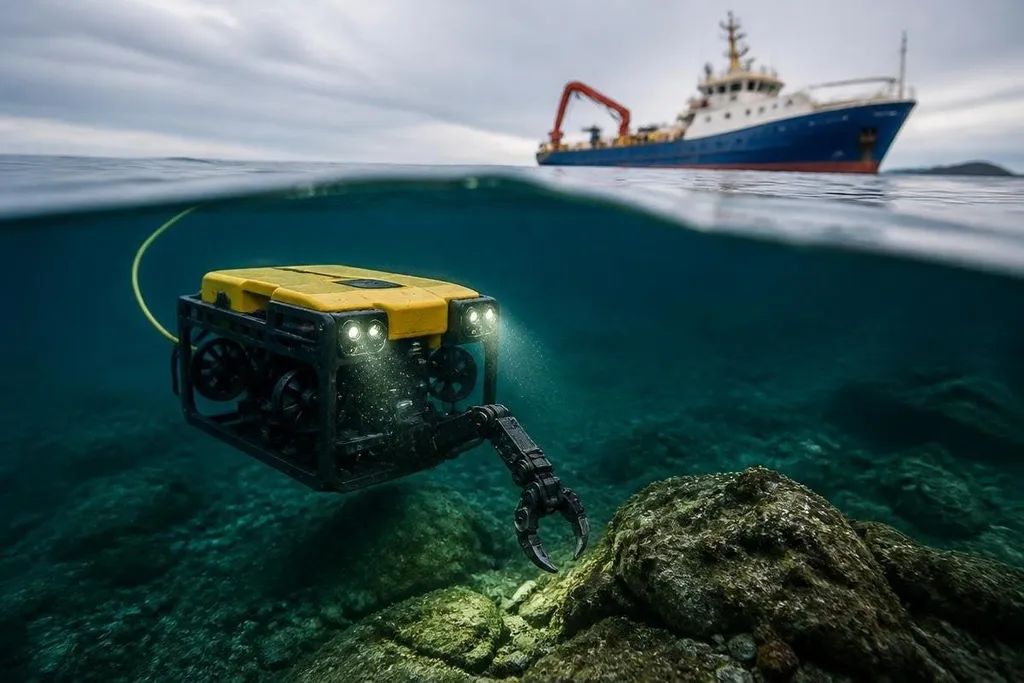
Underwater robots still work in places that are dark, cold, and hard for people to reach. Better control, clearer sensing, longer missions, and tools that can do useful work below the surface will shape the next gains.
This article focuses on the technology areas worth checking, rather than naming products without source material to support them.
Quick read
- Autonomous underwater vehicles can survey without a live cable to the surface.
- Sonar, cameras, and navigation software must work together when water blocks light and radio signals.
- A useful robot needs a clear task, a recovery plan, and proof from real water trials.
Robots that work without a cable
An autonomous underwater vehicle, or AUV, carries its own power and follows a planned route. An operator can set survey points, depth limits, and return rules before the vehicle enters the water.
That removes the cable used by a remotely operated vehicle, or ROV. An ROV sends power, video, and control signals through an umbilical, while an AUV must sense its position and manage its own decisions below the surface.
The hard part is navigation. GPS signals do not travel through seawater, so an AUV may combine inertial sensors, depth sensors, Doppler velocity logs, and sonar. Each tool gives a different piece of the robot's position, and errors can grow during a long mission.
A useful test is simple: can the robot return to the recovery point after its planned route, with enough battery left for the trip? A route on a screen proves little if the vehicle cannot finish the mission in changing currents.
Seeing through dark water
Cameras work well in clear, shallow water. They lose range as the water fills with silt, algae, or darkness. Sonar uses sound instead of light, so it can detect objects when a camera sees only a gray image.
Sensor cooperation is the next step. Sonar can mark the shape and distance of an object, while a camera can help identify its surface. The robot then has a better chance of telling a pipe from a rock before it moves closer.
That matters for inspection. A survey team needs more than a map. It needs a record that shows where damage sits, how large it is, and how the result compares with an earlier inspection.
An underwater robot’s result means more when the record names its sensor, control link, test site, and date. Dated reporting at Robot24.com can place those details beside the machine’s task and failure points. The next problem is physical: hands, power, and recovery.
Hands, power, and recovery
Survey work is easier than physical work. An inspection robot may carry cameras and sonar, while a repair robot needs an arm, an end effector, and enough control to handle force from water and the target object.
The gripper is where many plans meet the real site.
A tool must hold the object without blocking the camera, and the arm must keep its position when water pushes against it. Small errors matter when a robot must turn a valve or place a connector.
Power sets the mission limit. A battery-powered AUV must reserve energy for sensing, movement, and the return trip. An ROV avoids that battery limit through its cable, but the cable can catch on structures and restrict movement.
Recovery also needs a place in the design. A lost robot is an equipment problem, a search problem, and a cost problem. Any serious claim about long missions should state how the robot is found after a fault.
What remains unproven
Many underwater systems can collect data in controlled conditions. The harder question is how well they work when visibility changes, currents shift, and the seafloor differs from the training data.
I’d treat a video demo as an early sign, not proof of a working service. The useful evidence is a repeatable mission record with the site, task, sensors, operator role, faults, and recovery result.
A company may also claim autonomy when a person still watches every movement. That can be valid for an ROV, but the label should match the work being done. You need to know which decisions the robot makes and which ones stay with the operator.
A practical buying checklist
Before you compare an underwater robot, check:
- Task: survey, inspection, sampling, or repair
- Vehicle: AUV, ROV, or a system that can switch between modes
- Sensing: camera range, sonar type, depth sensor, and data format
- Control: planned route, live piloting, or shared control
- Recovery: return method, tracking method, and fault response
- Proof: named site, recorded mission, measured result, and repeat test
The best system for a survey team may be a small AUV with good data handling. A maintenance crew may need an ROV with an arm, a live camera feed, and a trained operator.
A future underwater robot worth buying will be the one that shows its full mission record: route, depth, task, power use, faults, and recovery. Until makers publish that evidence, the biggest breakthrough is still an open question.